top of page
Northern Ethiopia
The Heart of History
Northern Ethiopia is home to some of the country’s most iconic and unforgettable destinations.
Here you’ll find a unique blend of ancient history, spiritual traditions, and breathtaking landscapes that have drawn travelers for centuries.
Explore the historical treasures and natural wonders that make this region the cultural heartbeat of Ethiopia.
Bahir Dar, Lake Tana & Blue Nile Falls

Bahir Dar, meaning “sea shore” in Amharic, is a relaxed lakeside town on the edge of Lake Tana, Ethiopia’s largest body of water. Local fishermen still glide across its waters in papyrus tankwa boats, built the same way they were in ancient times.
Hidden along the shores and islands of Lake Tana are centuries-old monasteries, home to priceless treasures—vivid religious paintings, ornate crowns and crosses of gold and silver, and even the mummified remains of Ethiopian emperors.
Lake Tana is also the source of the Blue Nile River, which begins its epic journey to the Mediterranean here. Just outside Bahir Dar, the river plunges over cliffs to form the Blue Nile Falls, sending up cool mists and rainbow sprays. A walk in this area reveals not only dramatic scenery but also local birdlife, wildlife, and the daily rhythms of nearby villages.
Gondar– Africa’s Camelot

With its empowering 17th-century castles, Gondar has rightfully earned the title “Africa’s Camelot.” Founded in 1636 by Emperor Fasilidas, the city flourished as Ethiopia’s capital for more than two centuries. Its royal enclosure, dotted with castles built by successive emperors, still stands as a remarkable testament to Gondar’s golden age.
Among its treasures is the Debre Birhan Selassie Church, perched on a hill above the city. Inside, every wall is adorned with colorful biblical murals, while the ceiling—covered with rows of angelic cherubs—remains one of the most iconic images in Ethiopian art.
Gondar truly comes alive during Timket (Epiphany), one of Ethiopia’s grandest religious festivals. At the Bath of Fasilidas, the stone pool is filled with water, and thousands of worshippers gather to renew their baptismal vows in a powerful display of faith and tradition.
Axum – Cradle of a Great Civilization

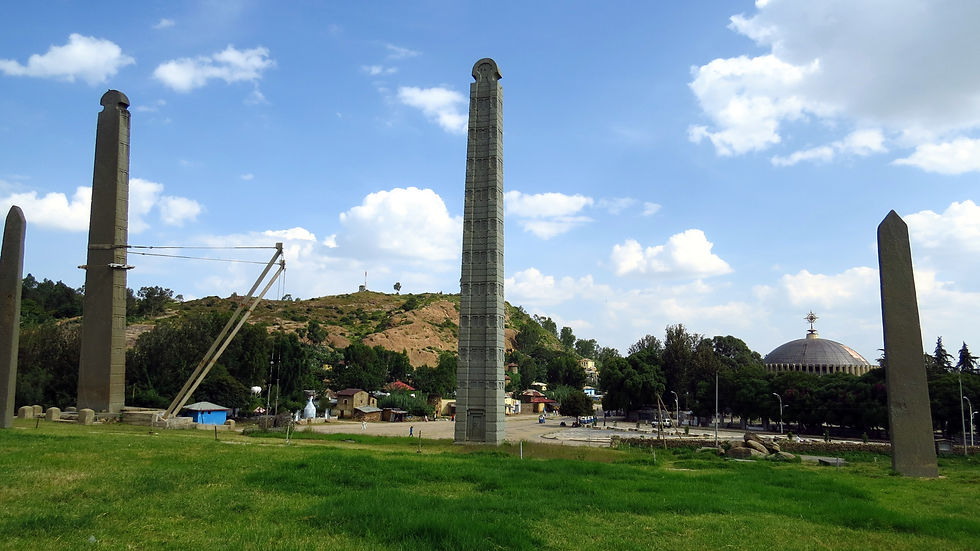
The many ancient tombs, castles, stelae, and artifacts found in Axum testify that this modest town was once the heart of one of the world’s great empires. From the 1st century BC to the 7th century AD, the Axumite Empire stood as one of the most advanced civilizations of its age, with far-reaching trade networks and remarkable engineering achievements.
Perhaps the most famous figure linked to Axum is the legendary Queen of Sheba (Makeda). Ethiopian tradition tells that when she visited King Solomon in Jerusalem, she bore him a son—Menelik I. Menelik would become Ethiopia’s first emperor and, according to legend, returned from Israel carrying with him the Ark of the Covenant.
Axum claims to house the Ark to this day, kept within a special chapel in the compound of St. Mary of Zion Church, guarded by a single monk whose sacred duty is to never leave the enclosure.
The city is also home to towering granite stelae, massive obelisks that serve as eternal symbols of Axum’s grandeur. The return of the largest stele from Italy in 2005 was celebrated across Ethiopia, restoring one of the nation’s most iconic monuments to its rightful place.
Lalibela - The New Jerusalem of Ethiopia

For nearly a thousand years, Lalibela has been one of Ethiopia’s holiest pilgrimage sites. To this day, thousands of Orthodox Christians and travelers from around the globe come to marvel at its 11 rock-hewn churches, carved directly into the bedrock with only the simplest of tools—an achievement so astonishing it feels almost otherworldly.
Like much of Ethiopia’s sacred heritage, Lalibela is steeped in legend. When Lalibela was a baby, he was found surrounded by a swarm of bees—interpreted as a prophecy of his future kingship. Later, poisoned by his jealous brother, he fell into a deep sleep and, according to tradition, was taken to heaven, where God commanded him to build a “New Jerusalem” in Ethiopia. After his brother’s repentance and abdication, Lalibela began the monumental project, and it is said that angels themselves continued the work by night.
The most iconic of these churches is Bet Giyorgis (St. George’s Church), cut in the shape of a cross and dedicated to Ethiopia’s patron saint. Local tradition even points to the hoofprint of St. George’s horse at the site as a sign of his blessing.
Today, Lalibela remains a center of living faith. Pilgrims gather in vast numbers for Genna (Ethiopian Christmas, January 7th) and for Timket (Epiphany, January 19th).
During Timket, replicas of the Ark of the Covenant (tabot) are carried from the churches in vibrant processions, and at dawn the waters are blessed and sprinkled upon the faithful, symbolizing renewal and unity.
Gheralta - The Rock-Hewn Churches of Tigray

Nothing testifies to the ancient roots of Christianity in Ethiopia more than the hidden rock-hewn churches of Tigray. Perched on remote mountain slopes, tucked into gorges, and carved into towering cliffs, these sanctuaries offer not only spiritual uplift but also breathtaking encounters with Ethiopia’s dramatic landscapes.
The Gheralta region is especially striking: massive buttes, reddish sandstone mountains, and sheer rock columns rise hundreds of meters above the valleys, their layered strata revealing millions of years of earth’s history. Against this backdrop, early Christians carved churches directly into the living rock—choosing the grandeur of the mountains over simple mud structures on the ground.
History and faith intersect here. After the decline of the Axumite Empire in the 7th century, Christians sought refuge in remote mountaintop sanctuaries to protect their holy sites from invaders. For centuries, these churches remained almost entirely hidden from the outside world—until their rediscovery in 1966.
Today, with new roads and improved accommodations, the churches of Tigray are more accessible. Yet they remain places of awe and reverence. To reach some, visitors must scramble up steep cliffs or squeeze through narrow rock passages—an effort richly rewarded by panoramic views and the quiet majesty of sanctuaries carved into stone.
Tigray Community Trekking

For those seeking the most authentic experience in Ethiopia, few places compare to the rural communities of the Tigray mountains. Here, travelers step away from the beaten path and into a world of dramatic landscapes, vibrant traditions, and warm hospitality.
The region’s striking red sandstone mountains shelter ancient rock-hewn churches, traditional farming villages, and sweeping vistas that stretch across valleys and ridges. Trekking trails wind through cultivated fields and up towering cliffs, offering plenty of opportunities to witness daily rural life—plowing with oxen, tending crops, and community gatherings that have changed little for centuries.
Nature lovers will also find much to admire. The mountains teem with wildlife: troops of playful Gelada monkeys, nimble hyrax, shy jackals, and an impressive variety of birdlife, from tiny sunbirds and delicate Cordon Bleu finches to the majestic Lammergeyer (bearded vulture) and Bateleur eagles soaring overhead.
Reaching these remote sites is possible only on foot—there are no roads into the heart of the mountains. Treks can be customized to suit every traveler, ranging from a single day’s walk to a 7-day immersive journey, with daily distances between 3 and 7 hours depending on fitness and interest.
Accommodation is part of the adventure: simple, community-owned guesthouses provide a warm welcome, eco-toilets, and basic wash facilities. What they lack in luxury, they more than make up for in authenticity, offering visitors a direct connection to the local culture and way of life.
Simien Mountains

The Simien Mountains National Park holds a special place in Ethiopia as the country’s only natural UNESCO World Heritage Site. Its dramatic landscapes—jagged peaks, sweeping plateaus, and plunging valleys—are among the most spectacular in Africa, often earning it comparisons to a “roof of Africa.”
This rugged highland is also a haven for rare and endemic wildlife. The most iconic resident is the Gelada baboon, sometimes called the “bleeding heart baboon” for the bright red patch on its chest. Unlike other baboons, Geladas are grass-eaters and are often seen in massive groups, grazing calmly on the alpine meadows—making sightings almost certain.
Other remarkable species include the Ethiopian wolf, the rarest canid in the world, found here in small numbers, and more prominently in the Bale Mountains. Perhaps most striking is the Walia ibex, a wild mountain goat found only in the Simien Mountains, leaping gracefully across sheer cliffs that would leave most humans frozen in fear.
Whether on a casual day trip or a multi-day trek, visitors to the Simien Mountains find themselves immersed in a world of breathtaking beauty and wildlife found nowhere else on Earth. It is an experience that stirs both awe and reverence for Ethiopia’s natural wonders.
The Danakil Depression

The Danakil Depression is one of the most extraordinary and other-worldly places on Earth—a land of extremes that rewards only the most adventurous travelers.
At 116 meters below sea level, Dallol is the lowest point on the African continent. Here, geothermal activity paints the land with a surreal palette of neon yellows, greens, and oranges—created by sulfurous springs and crystalline salt formations. It looks less like Earth and more like a scene from another planet.
The Danakil is also home to 40% of Africa’s volcanoes. The most famous, Erta Ale, is an active shield volcano whose permanent lava lake has earned it the title “the gateway to hell.” To escape the searing heat, treks are made at night, climbing under the stars and arriving at the rim just in time to see the fiery spectacle glow against the dawn sky—a sight few forget.
Because of its remoteness and harsh environment, visiting the Danakil is done in full-expedition style: convoy vehicles, local guides, security escorts, and all provisions brought in. Every detail is carefully managed to allow visitors to safely experience this remarkable corner of the world, where nature shows both its most beautiful and most brutal faces.
Bahir Dar
Gondar
Axum
Lalibela
Gheralta
Community Trekking
Simien
Danakil
Debra Libanos
Debra Libanos

Debre Libanos is among the most significant monasteries in Ethiopia and a key center of Ethiopian Orthodox Christianity. For centuries, it has served as a spiritual hub and pilgrimage destination, drawing believers seeking devotion, reflection, and connection to their faith.
The monastery is set amidst stunning natural scenery, perched above the Jemma River Gorge. Visitors are treated to breathtaking views of deep gorges, verdant cliffs, and the serene flow of the river below—a landscape that perfectly complements the spiritual atmosphere of the site.
bottom of page